
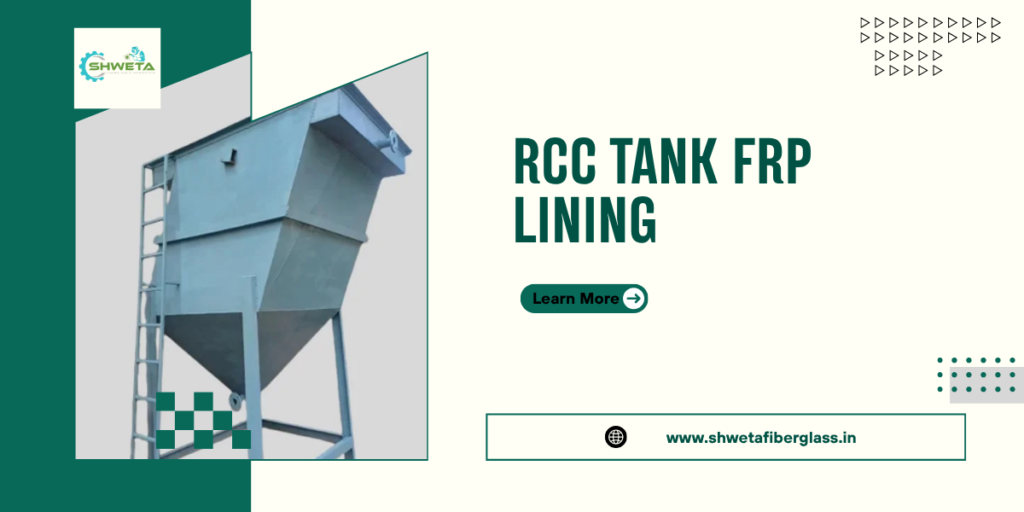
RCC and concrete tanks are commonly used for water storage, wastewater treatment, industrial processes and utility applications. Although reinforced concrete provides a strong structural base, prolonged exposure to moisture, chemicals and aggressive liquids can affect the internal surface. RCC Tank FRP Lining provides a protective composite layer over suitable concrete surfaces, helping reduce direct contact between the substrate and the stored material.
What Is RCC Tank FRP Lining?
RCC Tank FRP Lining is a Fibre Reinforced Plastic lining system applied to the internal surface of a reinforced cement concrete tank. The system typically combines resin with reinforcing fibres to create a continuous protective layer after application and curing.
The condition of the concrete surface is an important part of the process. Loose particles, dust, laitance, contaminants and damaged areas may need to be removed or repaired before the FRP system is installed. Proper substrate preparation helps create better bonding between the RCC surface and the lining.
Depending on the application, the lining system can be selected according to the type of liquid, chemical exposure, operating conditions and required level of protection.
Why Is FRP Lining Used for RCC Tanks?
Concrete surfaces can absorb moisture and may be affected by certain chemicals or aggressive liquids over time. Cracks, surface deterioration and repeated exposure can also increase maintenance requirements.
A suitable FRP lining can provide an additional protective barrier over the internal surface. It may be considered for:
- Water storage tanks
- Industrial process tanks
- Wastewater tanks
- Effluent treatment systems
- Chemical handling areas
- Utility tanks
- Process and storage structures
The exact system should be selected based on the tank condition and the material that will come into contact with the lining.
Benefits of RCC Tank FRP Lining
Surface Protection
The FRP layer can help protect the prepared RCC surface from direct exposure to compatible liquids and chemicals.
Moisture Barrier
A properly applied lining can provide a protective surface that helps reduce moisture contact with the underlying concrete.
Chemical Protection
Resin selection can be matched to the expected chemical environment, concentration and operating conditions.
Improved Maintenance
Protecting the internal surface can help reduce deterioration-related maintenance when the underlying RCC structure is suitable for lining.
Customized Thickness and Reinforcement
The lining configuration can be planned according to tank dimensions, substrate condition and project requirements.
RCC Tank FRP Lining Process
The process begins with an inspection of the existing tank and assessment of the RCC surface. Damaged or unsuitable areas may require repair before the lining work begins.
The surface is then cleaned and prepared to remove dust, loose concrete, laitance, oil and other contaminants. A suitable bonding or resin layer can then be applied before installing the required reinforcement.
FRP layers are applied systematically over the prepared surface, with attention given to corners, joints, edges and other areas that may require additional reinforcement. The completed lining is allowed to cure according to the selected system before final inspection.
Proper surface preparation is especially important because moisture or weak substrate conditions can affect adhesion and the performance of the finished lining.
Applications of RCC Tank FRP Lining
RCC tank lining can be useful in industries involving water treatment, wastewater management, chemical handling, manufacturing and industrial utilities. It can also be considered when an existing concrete tank needs additional internal surface protection.
For other tank substrates, explore FRP Tank Lining and MS Tank FRP Lining. For wastewater and effluent applications, ETP Tank Lining can be explored, while Acid Proof FRP Coating is relevant for projects requiring protection against suitable acidic environments.
Shweta Fiberglass supports RCC tank lining requirements in Ahmedabad, serving industrial applications across Ahmedabad, Gujarat and throughout India. Choosing the appropriate FRP system based on the substrate, stored material and operating environment can help create a more durable protective surface for suitable RCC tanks.
 Users Today : 7
 Users This Month : 7
 Total Users : 103
